What is Hashing?#
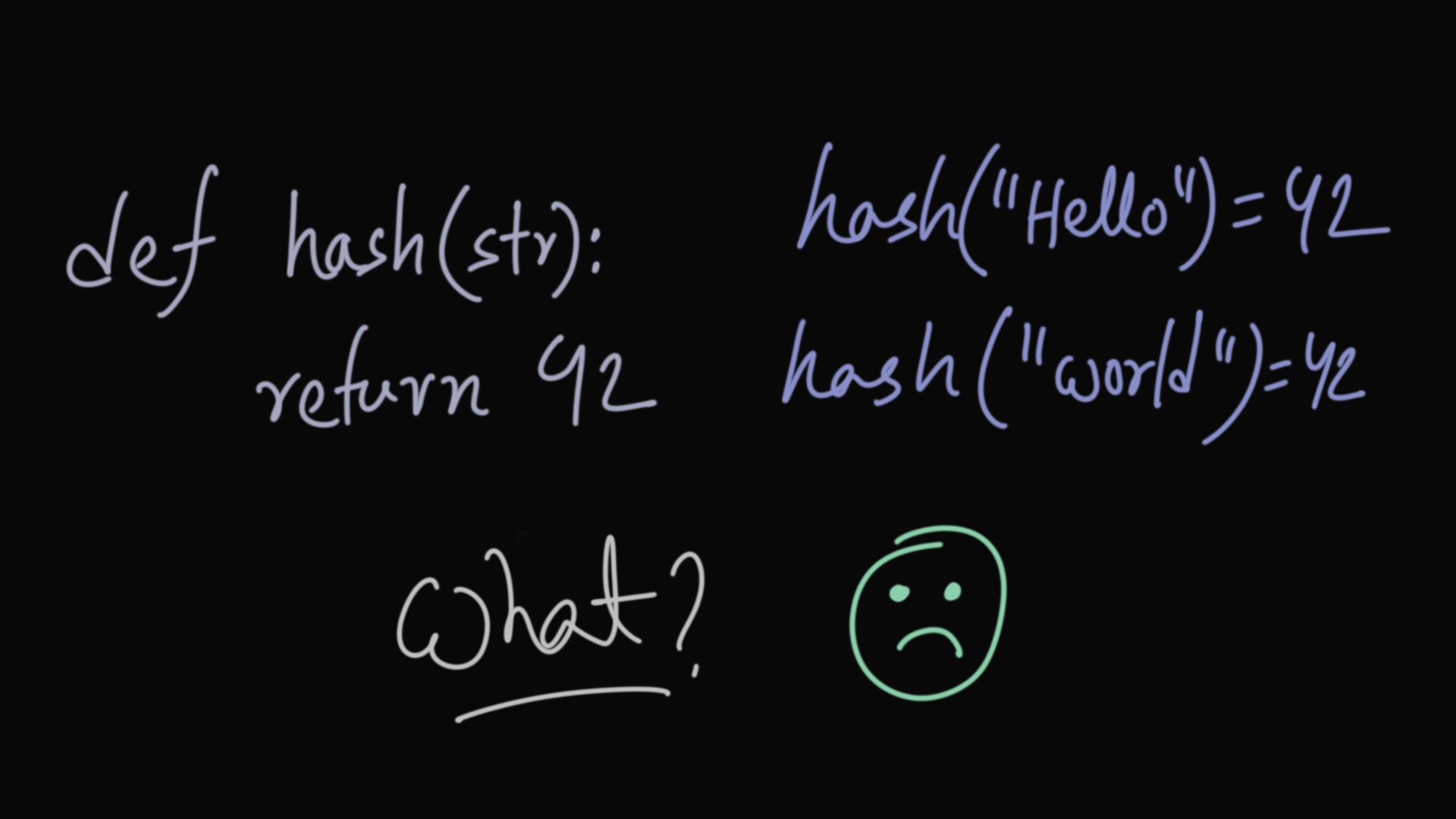
Let’s think about a function unsigned int hash(string). This function will take a string as a parameter and return a unique ID let’s say an unsigned integer. This is called a hash function. It’ll generate a unique ID for every unique string. And same unique ID over and over for same string. Things get complicated when the two different strings generate same ID. This is called a hash collision.
Hashing in C++#
Let’s use std::hash to generate hash for some string.
#include <functional> // std::hash
#include <iostream>

int main() {
    std::hash<std::string> str_hash;
    std::cout << str_hash("Hello") << '\n';
    std::cout << str_hash("World") << '\n';
}
This syntax can be somewhat simplified to this. (maybe ?)
#include <functional> // std::hash
#include <iostream>

int main() {
    std::cout << std::hash<std::string>{}("Hello World!") << '\n';
}
Well, we’ve used the std::hash function to generate hash. But we don’t know yet which algorithm it uses! Let’s use some easy string hashing algorithm.
djb2 Hashing algorithm#
This algorithm is very simple yet powerful enough to generate some good hash.
unsigned long hash(unsigned char *str) {
    unsigned long hash = 5381;
    int c;

    while ((c = *str++))
        hash = ((hash << 5) + hash) + c; /* hash * 33 + c */

    return hash;
}
Let’s use this algorithm.
#include <iostream>

namespace djb2 {
std::size_t hash(uint8_t *str) {
    std::size_t hash = 5381;
    int c;

    while ((c = *str++))
        hash = ((hash << 5) + hash) + c; /* hash * 33 + c */

    return hash;
}

std::size_t hash(const std::string &str) {
    return hash((uint8_t *)str.c_str());
}

} // namespace djb2

int main() {
    std::string s = "Hello World";
    std::cout << djb2::hash(s) << '\n';
}